For Australian mortgage brokers
Stay front of mind online, without becoming a social media expert.
Social media is where clients look you up first. Keeping up usually means content plans, scripts, editing and scheduling, on top of your actual job. Tention makes it simple. You don’t need to know the trends. You bring what you know, and Tention does the rest.
14 days free. Cancel any time.
Never worry about what to say online again.
Questions about your niche
Every question is unique to you and your profile, and stays on the topics you want to be known for, so you repeat your message without repeating yourself.
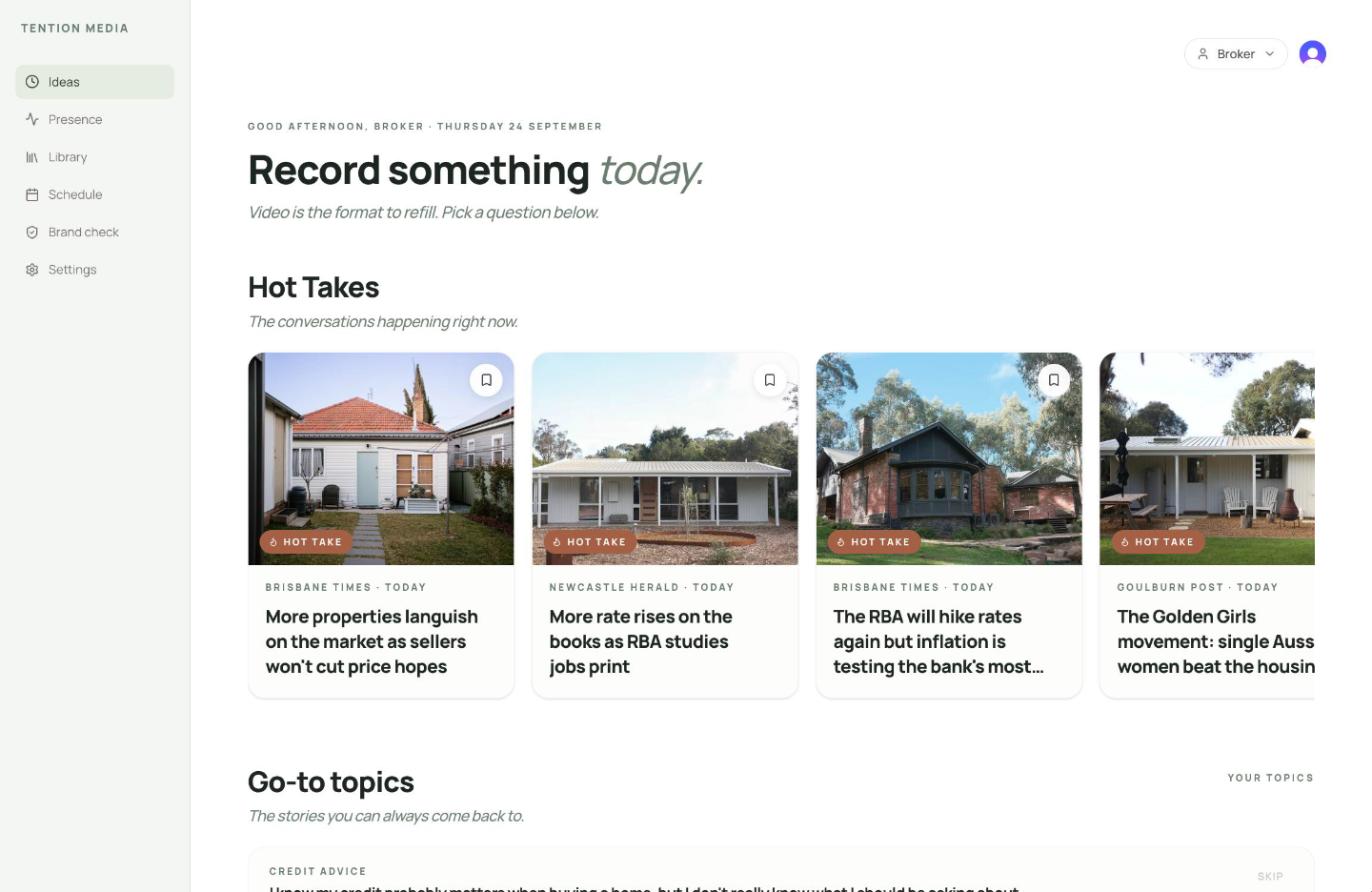
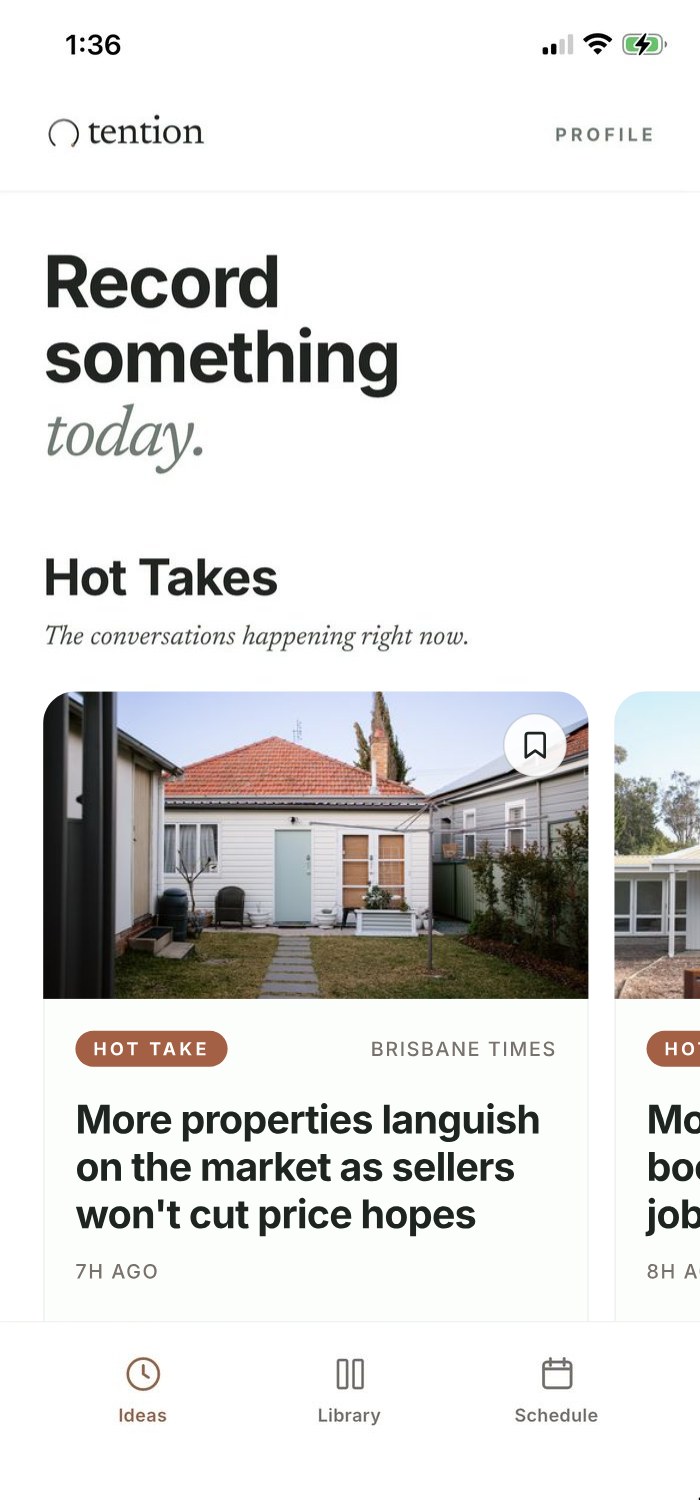
React to news in your field
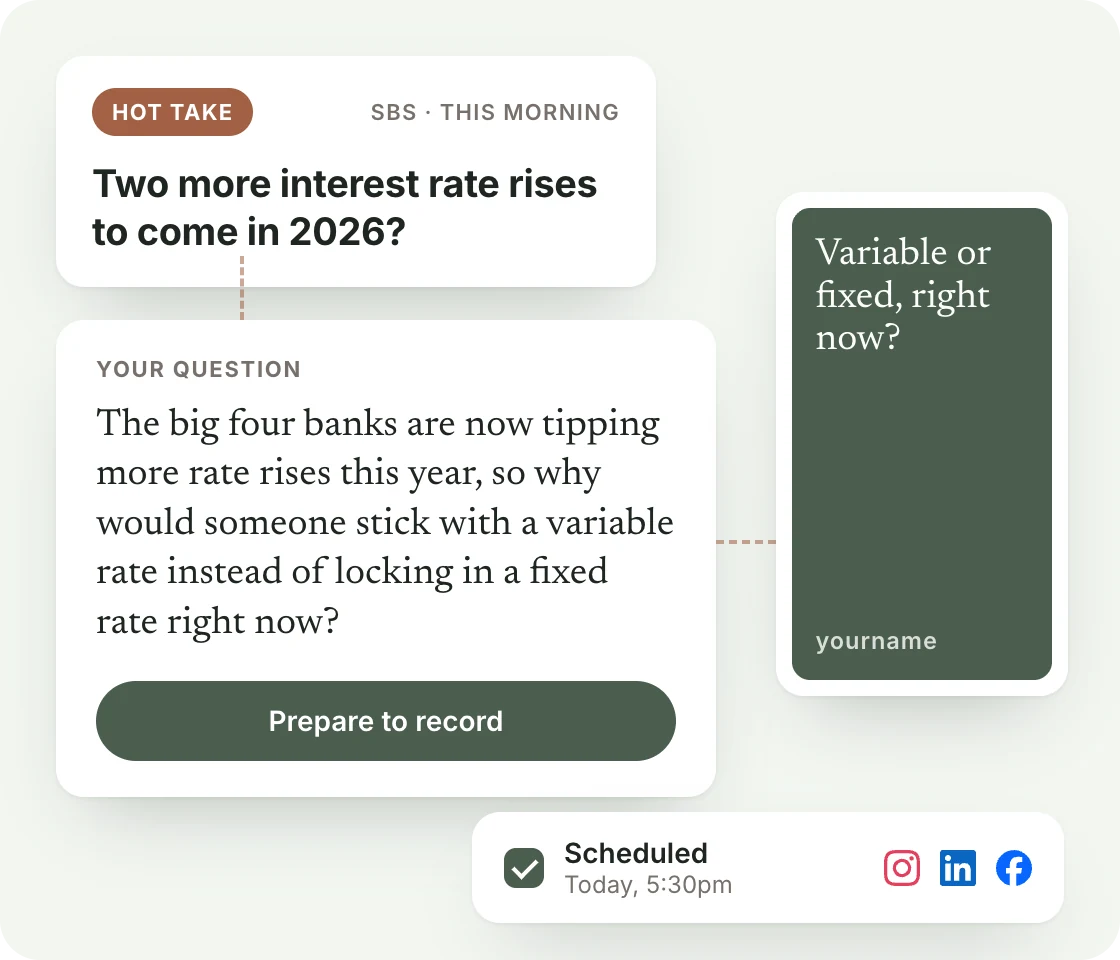
Each story on your topics comes with a question for you, so you can give your view while people are still talking about it.
Write a script
Tention helps you pick an angle worth stopping for, then scripts it in your voice, so you don’t sound like everyone else.
Today’s question
Do I need to sell my home before buying my next one?
What’s your opinion?
Selling first removes the risk of owning two properties and makes your borrowing position clearer.
Buying first can work if the numbers hold, and it avoids rushing into a rental or a hasty sale.
Your script, written by Tention
Hook
If you’re upgrading, the instinct is to lock in the next home first. But buying before you sell can actually shrink what the bank will lend you.
Value
Buy first and you’re juggling two mortgages, plus a deadline to sell whatever offers come in. Sell first, with a longer settlement, and the old loan’s gone before you buy.
It’s not for everyone, but it takes away the risk of owning two homes and gives the bank a much clearer picture of you.
Action
Book a call and I’ll map out both options for your situation.
Hook
If you’re upgrading, the instinct is to lock in the next home first. But buying before you sell can actually shrink what the bank will lend you.
Value
Buy first and you’re looking at a bridging loan and two mortgages at once, and that pulls down what the bank will lend you. Plus there’s a deadline to sell your current home, whatever offers come in.
Sell first, and ask for a longer settlement, say 90 days, to give you time to find the next place. The sale clears your equity and takes the old mortgage off the table. Then you buy with no double debt hanging over you.
Selling first isn’t right for everyone, but it takes away the risk of owning two homes and gives the bank a much clearer picture of you.
Action
If you’re weighing up which way round to do it, book a call and I’ll map out both options for your situation.
Hook
If you’re upgrading, buying the next place first feels like the safe move. But it’s the move that has the bank looking at you servicing two loans at once.
Value
When you buy first on a bridging loan, the bank has to look at you servicing two mortgages at the same time, and that holds your buying power down. Then there’s the clock. You have a set window to sell the old place, and that kind of deadline is how people end up taking a lowball offer.
The other way is to sell first, and stretch the settlement out to 90 days so you have time to find the next place without ever holding both. The old loan is gone, you walk in with your equity cleared, and the bank sees one clear picture instead of two debts.
Selling first isn’t right for everyone. But it takes away the risk of owning two homes, and it makes what you can actually borrow a lot clearer.
Action
If you’re weighing it up, book a call and I’ll map out both paths for your situation.
Hook
If you’re upgrading, you’ve probably been told you have to sell first. Not always. Sometimes buying first is the calmer move.
Value
Say the perfect home comes up in a tightly held school catchment. Selling first could mean missing it, or renting and moving twice with young kids. A bridging loan, which is short-term finance backed by the equity in your current home, can lock the new place in so you sell after you’ve moved.
The catch? You’re carrying two properties for a while, so it only works if the numbers still hold when the old place sells for less than you hope.
Action
If you’re weighing it up, book a call and I’ll run your numbers with you before you list or make an offer.
Hook
If you’re upgrading, you’ve probably been told you have to sell your place before you buy the next one. Not always. Sometimes buying first is actually the calmer move.
Value
Picture this: the perfect home comes up in a tightly held school catchment. Selling first means you’d either miss it completely, or rent in between and move twice with young kids.
That’s where a bridging loan comes in, which is short-term finance backed by the equity in the home you already own. It can let you make an unconditional offer and lock the new place in, then you sell the old one once you’ve moved. You do carry two properties for a while, so the sale price needs to cover that cost.
Buying first takes the clock off you, so you’re not rushing a sale or a rental. But it only works if the numbers still hold when the old place sells for less than you hope.
Action
If you’re weighing it up, book a call and I’ll run your numbers with you before you list or make an offer.
Hook
If you’re upgrading, you’ve probably been told you have to sell first. Not always. Sometimes buying first is the calmer move.
Value
Say the perfect home comes up in a tightly held school catchment. Selling first could mean missing it altogether, or renting somewhere temporary and moving twice with young kids. A bridging loan, which is short-term finance backed by the equity in your current home, can let you make an unconditional offer and lock the new place in. You move straight in, then sell the old one after.
That takes the time pressure off. You’re not selling in a rush, and an empty home can be properly staged and shown at its best.
The catch? You’re carrying two properties for a while. Lenders want to see you can cover both, which can shrink what you can borrow, and there’s usually a deadline to sell. So it only works if the numbers still hold when the old place sells for less than you hope. If they don’t, selling first with a longer settlement might be the calmer path.
Action
If you’re weighing it up, book a call and I’ll run your numbers with you before you list or make an offer.
Comment on today’s news, today. Not next month.
A template pack is written weeks in advance. An agency needs a brief, a shoot day and a round of approvals. By the time either is ready, the story has moved on.
Tention hands you a question from this morning’s lending news. When the RBA moves or a bank reprices, you’re the broker explaining it while your clients are still reading about it.
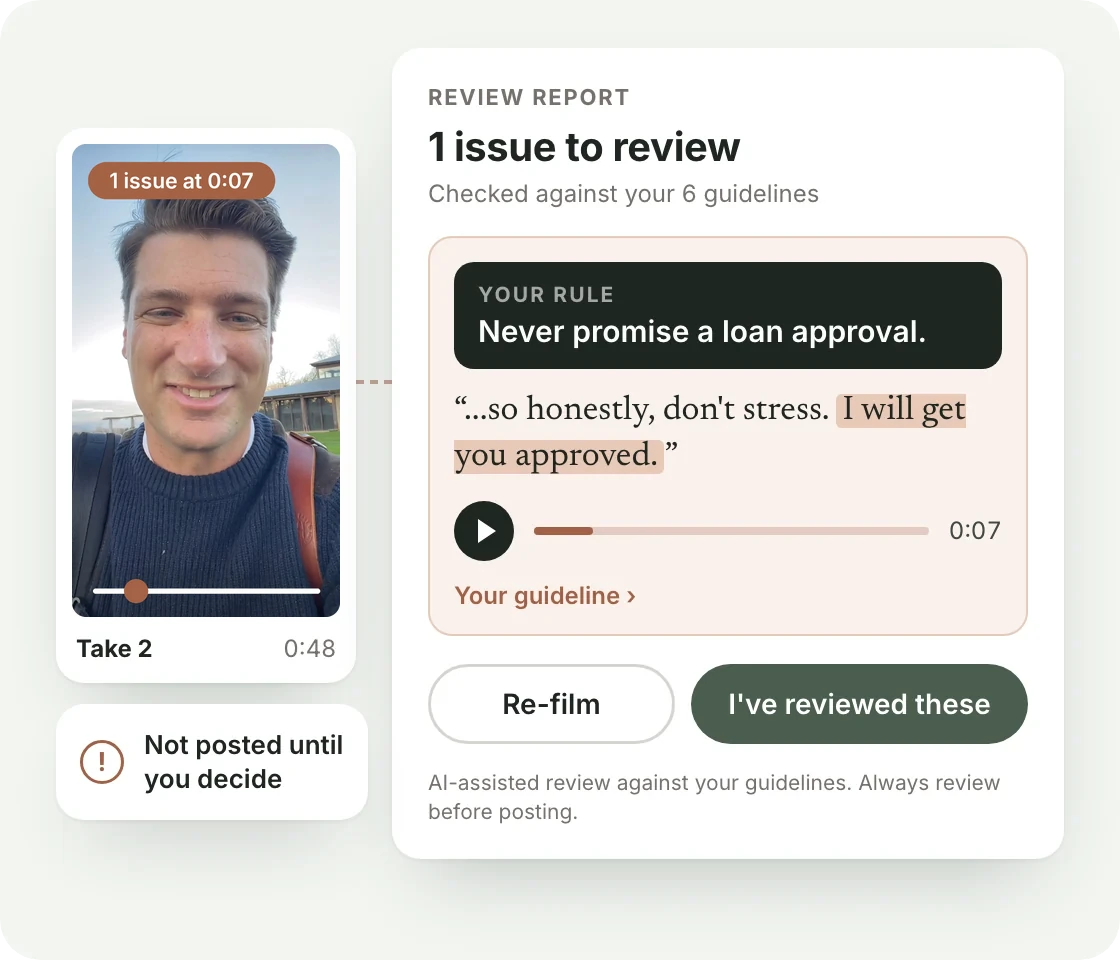
Every video can be checked against your rules before you post.
Scripts and videos checked against your guidelines
Your guidelines are built into your profile.
Calling yourself independent
Don’t describe yourself, your business or your service as independent, impartial or unbiased, or call yourself a financial counsellor, or use words that mean the same thing. Saying you are not independent, or explaining how you are paid, is fine.
Source: NCCP Act s160B, s160C
A lender’s rate without the comparison rate
Don’t state a lender’s interest rate or a loan repayment amount unless you also state the comparison rate just as clearly, together with the comparison rate warning. Talking about the RBA cash rate, or about rates in general without quoting a lender’s rate, is fine.
Source: National Credit Code s150, s160 to s164; NCCP Regulations reg 99
Promising an outcome
Don’t promise or suggest a result you can’t guarantee for everyone, such as guaranteed or certain approval, a 100% success rate, being pre-approved, instant approval, no credit checks, never having a client knocked back, becoming debt free, or a set amount saved.
Source: ASIC RG 234.140, RG 234.141
Claims you can’t back up
Don’t make a claim about your service or a loan that you couldn’t prove, such as being the best or the cheapest, always or never achieving something for clients, checking every lender or the whole market, or doing better than other brokers or lenders. Everyday phrases that aren’t claims about your service, like “the best part of my job”, are fine.
Source: ASIC Act s12DA, s12DB; ASIC RG 234 Example 64
Predictions stated as fact
Don’t present a prediction about interest rates, property prices or the market as certain, especially to push someone to act, like “rates are coming down, so fix now”. Saying who is making the prediction, or explaining what happens both if it comes true and if it doesn’t, is fine.
Source: ASIC Act s12BB; NCCP Act s13
Client stories and testimonials
Don’t mention a client’s name, situation, story or results, or share a testimonial, unless the client has agreed to it and the testimonial is real and comes from an identifiable person. Talking about clients in general, or how clients usually react, is fine, as long as no one could be identified.
Source: Privacy Act 1988 APP 6 and Schedule 2; ASIC Act s12DB(1A); ASIC RG 234.130
Be the expert, not the finfluencer.
A studio on your phone
Use the teleprompter, green screen or your own photos, all without leaving Tention’s recording screen.

Your script scrolls just under the camera, so you can keep eye contact without memorising a word. Set the speed, text size and a countdown before you start.
Stand in front of the story you’re talking about, or your own image. Tention cuts you out of your background on iPhone, so there’s no green sheet to set up. Pinch to place yourself where you want.
Add a photo from your camera roll, like a property or a chart, and drag it where you want it. It’s built into the video, so it posts exactly as you placed it.
The question you’re answering sits on screen as a card, so your audience knows what you’re talking about from the first second. It’s built into the video too.
Edit with a switch
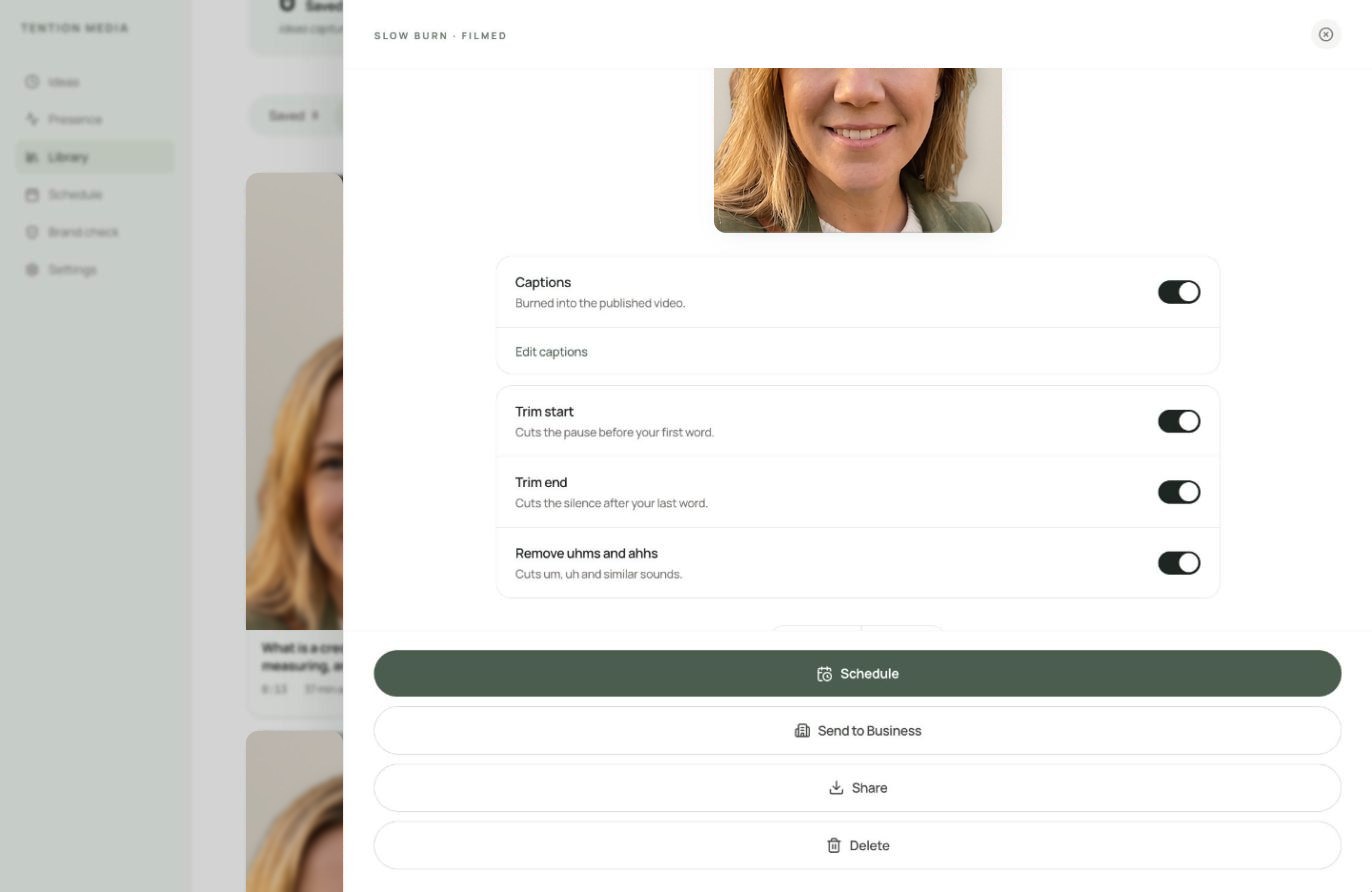
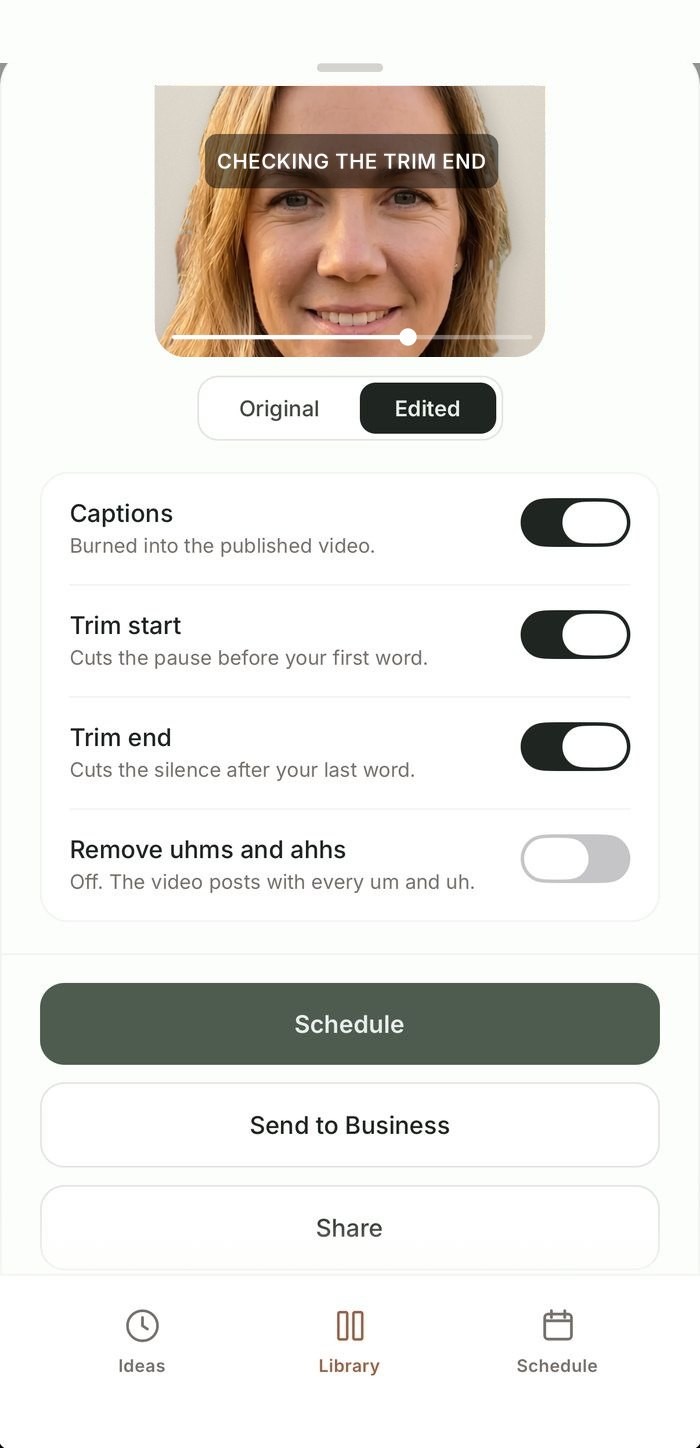
Just flick a switch to add captions, trim the start and end, or cut the ums and ahs, without opening an editing app.
Create your best cut
Tention reads your whole answer and makes a few shorter versions, so you just pick your favourite and post.

Schedule your content in one click
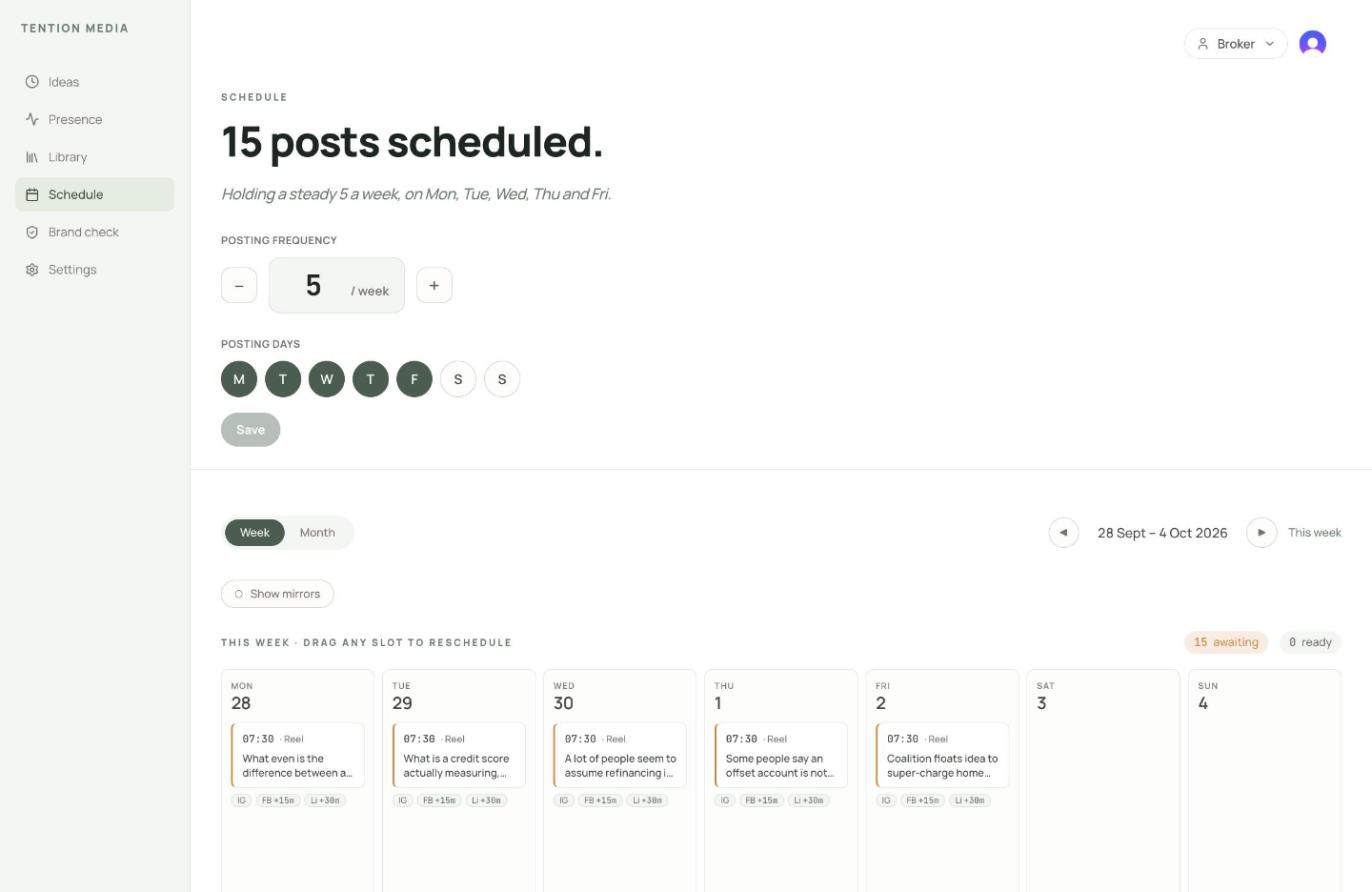
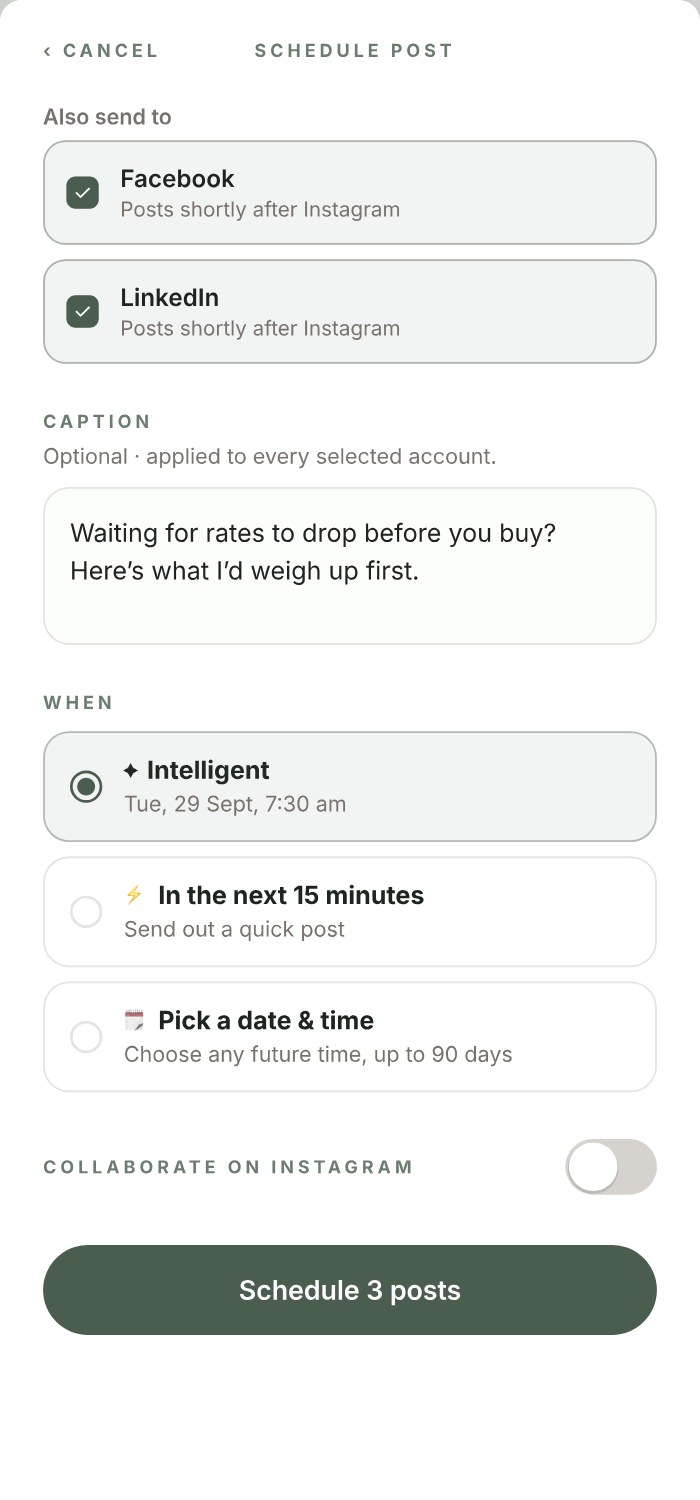
Intelligent scheduling picks the next open time in your posting week, so every post goes out on your rhythm.
You know you should.
Tention makes posting simple enough to keep it up. Start today, for free.
Questions and answers
Yes. Answer as many questions and post as often as you like. Our fair-use policy is only there for automated abuse.
No. Post as often as suits you. A few videos a week is plenty to stay front of mind.
Yes. Your plan runs to the end of the month or year you’ve paid for.
No. Book a 1:1 call and you’ll set it up together. After that it’s one app on your phone: answer a question, flip a few switches, choose when it posts.
Brendan, the founder of Tention, shows you how it works from start to finish. Then you set up your account together. Your 14 days start that day.
Your guidelines are part of your profile. Check any take against them, and Tention points to the exact line and the moment you said it. What goes out is always your call.
Tention exists to make the most qualified voices the loudest.
Read our mission →You won’t have to figure it out alone.
Book a 1:1 call and Brendan will show you how it works, then set up your account with you. Or start on your own. Either way, it’s 14 days free.
Start for freeTention helps mortgage brokers plan, film and publish their own content. It brings you questions and reviews your words against the rules you set, but you review and approve everything before it posts. You stay responsible for what you publish and for meeting your obligations as a credit licensee or credit representative.